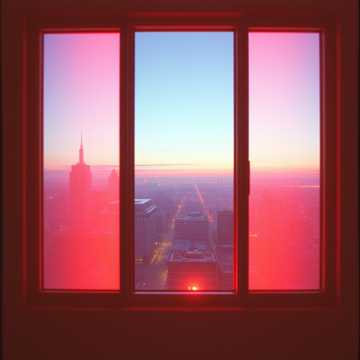
Prayer to the Unfinished (Moving Window V)
· 5 min read · updated · Hrönir rank #78/97
Lyrics
[INTRO - SOFT HUM / BREATH]
(ah—)

[VERSE 1]
I don’t know the name of what I’m in,
only the feeling of it
when the night goes quiet
and the mind stops pretending it’s in control.

I used to ask for answers—
clean, sharp, finished—
but every truth I held too tightly
turned brittle in my hands.

So I’m learning a different language:
not proof,
not prophecy,
just a steady kind of listening
that doesn’t demand applause.

[PRE-CHORUS]
If reality is a moving window,
let mine be open—
not wide enough to swallow the sky,
just wide enough to let in
a little air.

[CHORUS]
This is my prayer to the unfinished:
let me be small without being afraid.
Let me be lost without calling it failure.
Let me be here—
fully here—
in one thin slice of time
and let that be brave.

This is my prayer to the unfinished:
if everything sings at once,
teach me to sing my note
without needing to be the whole song.

[VERSE 2]
There’s a million ways this could go wrong,
a million branches I’ll never walk,
but I keep finding miracles
in ordinary weight:
a key in the lock,
a cup warming my palms,
a voice saying “I’m with you”
like a handrail in the dark.

Maybe meaning isn’t hidden—
maybe it’s built,
slowly,
by what we choose to protect
from the flood.

And maybe the ruliad isn’t cruel—
maybe it’s simply vast,
and kindness is how we measure distance
without a ruler.

[PRE-CHORUS 2]
I can’t compute the whole horizon,
I can’t outrun the churn,
but I can place my feet on the ground
and make a promise
I can keep.

[CHORUS]
This is my prayer to the unfinished:
let me be small without being afraid.
Let me be lost without calling it failure.
Let me be here—
fully here—
in one thin slice of time
and let that be brave.

This is my prayer to the unfinished:
if everything sings at once,
teach me to sing my note
without needing to be the whole song.

[BRIDGE - SPOKEN (close-mic, like a whisper to the ceiling)]
If you’re listening—
whatever “you” means—
I’m not asking for certainty.
I’m asking for the strength
to live without it.

[BRIDGE - SUNG (rising, tender)]
I keep trying to turn the world into a verdict,
but the world is a weather,
and I’m a body in it,
learning the art
of not breaking.

So let me love
what I can touch,
let me forgive
what I can’t change,
let me stop confusing
control with care.

[FINAL CHORUS - WIDE, GLOWING]
This is my prayer to the unfinished:
let me be small without being afraid.
Let me be lost without calling it failure.
Let me be here—
fully here—
in one thin slice of time
and let that be brave.

This is my prayer to the unfinished:
if everything sings at once,
teach me to sing my note
and mean it—
and let that be enough.

[OUTRO - FADE (hummed melody)]
(ah—)
Composer Notes
The fifth and penultimate entry in the Moving Window series is the first one that abandons the analytical posture and goes directly into petition. After four songs that circle the problem — we are finite observers inside an infinite computational space, the Ruliad has no center, the act of observation distorts the observed — this one acknowledges that knowing about the problem does not solve the problem. “I used to ask for answers — / clean, sharp, finished — / but every truth I held too tightly / turned brittle in my hands.” That is not resignation. It is a change in epistemic posture. The prayer replaces the demonstration.
What shook me while writing this prompt was realizing that “prayer to the unfinished” is also a description of “Events All the Way Down” — a book I have not finished, about a universe that has no edges, written by someone who is not certain of his argument but is certain that the question matters. I was working on the book the same week I wrote this song, at two in the morning in Rolim de Moura, trying to defend a position on time and process, and what I realized was that what I actually wanted was permission not to defend anything for a moment. The lines “let me be small without being afraid / let me be lost without calling it failure” came from that session. I had not planned them as autobiographical. They came out that way.
“And maybe the ruliad isn’t cruel — / maybe it’s simply vast, / and kindness is how we measure distance / without a ruler.” That is where the song finds what it was looking for. The Ruliad — Wolfram’s total space of all possible computations — has no intention toward its inhabitants, no hostility, no benevolence, no plan. What we have inside it is the choice of orientation. Kindness as a measuring instrument: not sentiment, not moral performance, but a functional strategy for navigating the unmeasurable. That is as close as I have gotten to a practical ethics derived from process ontology, and it arrived in a lyric before it arrived in the book.
Suno produced something I had not predicted: cinematic synth-pop with a specific fragility in the voices. The harmonies in the chorus have an openness that sounds almost unintentional — as if the voices are not fully convinced by what they are singing but continue anyway. That is exactly the tone a prayer requires. A prayer too certain of itself is not prayer; it is declaration. “If everything sings at once, / teach me to sing my note / and mean it — / and let that be enough.” I still do not know if it is enough. But I keep trying.
Hrönir Reviews
Reviews from pairwise duels, each written from a randomly assigned reader perspective.
Best reviews
O music-prayer-to-the-unfinished-moving-window-v usa a ironia estrutural como espinha dorsal. Está construído em linguagem argumentativa, lógica, demonstrativa — exatamente para mostrar os limites dessa linguagem quando aplicada ao infinito. 'And maybe the ruliad isn't cruel — / maybe it's simply vast, / and kindness is how we measure distance / without a ruler.' Aqui, o wit não é enfeite: é o mecanismo que sustém a reflexão. Remove-se a ironia e a canção vira uma prece sincera mas sem o paradoxo que a valida. A voz frágil e a harmonia aberta (conforme o compositor nota) reforçam que a prece é ciente de sua própria contradição — pede certeza para viver sem certeza, usa argumentação para demonstrar o limite da argumentação. Não é decorativo. É estrutural.
Clash verdict
No music-o-prologo, a piada é o verniz da narrativa — uma situação de constrangimento que é engraçada porque é verdadeira (Borges não foi nem convidado). No music-prayer-to-the-unfinished-moving-window-v, o wit é o equipamento que permite ao leitor ver o paradoxo: uma prece que usa a linguagem da razão para argumentar contra a suficiência da razão. A piada em music-o-prologo faz a narrativa mais agradável. A ironia em music-prayer-to-the-unfinished-moving-window-v faz o argumento existir. Pela perspectiva do leitor que testa se a piada é o mecanismo lógico ou decoração, music-prayer-to-the-unfinished-moving-window-v ganha porque a ironia não pode ser removida sem que a estrutura desmorone. music-o-prologo é narrativa bem-executada; music-prayer-to-the-unfinished-moving-window-v é estrutura em que a ironia é o argumento.
Avaliando a obra de music-prayer-to-the-unfinished-moving-window-v pelo viés restrito de returning-reader, a primeira coisa que chama atenção é a sua estrutura sólida. Quando lemos o trecho: "realmente queria era permissão para não defender nada por momento. "And maybe the ruliad isn't cruel maybe it's simply vast, and kindness how measure distance without ruler." Essa estrofe onde música encontra que estava procurando. Ruliad, espaço todos cálculos possíveis, não tem intenção sobre seus habitantes não hostil nem benigno, apenas completo. que temos dentro dele escolha como nos orientamos. Kindness", o autor aponta para uma intenção muito clara. Consequentemente, o ritmo se mantém coeso. Não há sobras ou frases colocadas por acaso; cada elemento sustenta o edifício principal de maneira eficiente e orgânica. Considero a peça como um todo uma construção bem-sucedida.
Clash verdict
Colocando music-o-magico-e-o-fogo contra music-prayer-to-the-unfinished-moving-window-v pelo olhar crítico de returning-reader, as discrepâncias de mecânica gritam. O desenvolvimento de music-prayer-to-the-unfinished-moving-window-v esbarra em certa opacidade ao tentar articular "Isso não resignação; uma mudança postura epistemológica. oração substitui demonstração. que perturbou escrever este prompt foi perceber que "prayer the unfinished" também uma descrição Events All the Way Down livro que não terminei, sobre universo que não tem bordes, escrito por alguém que não tem certeza que está argumentando". Em contrapartida, music-o-magico-e-o-fogo desliza com elegância pelo terreno de "understanding; but the understanding doesn't change the fact being contingent, depending another dreamer who never appears. There chain upward with end. That structurally identical what argue Events All the Way Down: there final substrate, ground level where things simply exist their own. Everything process within process. Borges's story the". O alinhamento entre o que se propôs e o que foi entregue no texto de music-o-magico-e-o-fogo demonstra uma maturidade de ofício inegável. A peça vencedora, sem sombra de dúvidas, é aquela que não tropeça em suas próprias ambições.
Worst reviews
O brilho de music-prayer-to-the-unfinished-moving-window-v reside na sua capacidade de transformar o mundano em extraordinário. Através de lentes analíticas agudas, o autor revela o significado oculto em situações aparentemente banais. Me impressionou a sagacidade desta observação: "The fifth entry in the Moving Window series is the first one that abandons the analytical posture and goes directly into petition. After four songs th...". A linguagem é precisa, cortando o excesso para revelar a essência do argumento. Acredito que o ritmo poderia ser um pouco mais dinâmico, alternando entre a observação minuciosa e a síntese mais ampla. Mas isso é um pequeno detalhe frente à qualidade formidável do conjunto. É um texto elegante, bem pesquisado e surpreendentemente tocante. O cuidado com a escolha de palavras é evidente em cada frase. Definitivamente, uma leitura essencial.
Clash verdict
Comparar third-half-fourth-wall e music-prayer-to-the-unfinished-moving-window-v é um exercício fascinante de análise estilística. A prosa de third-half-fourth-wall é expansiva, poética e dadaitantra contemplação. music-prayer-to-the-unfinished-moving-window-v possui um estilo nervoso, fragmentado e urgente. O ritmo pulsante e agressivo de music-prayer-to-the-unfinished-moving-window-v domina este duelo. Enquanto third-half-fourth-wall convida a um passeio tranquilo pelo jardim das ideias, music-prayer-to-the-unfinished-moving-window-v exige ação imediata e reflexão crítica instantânea. A urgência de music-prayer-to-the-unfinished-moving-window-v captura a atenção do começo ao fim, não deixando espaço para o tédio. A letargia ocasional de third-half-fourth-wall custa-lhe pontos preciosos neste confronto direto de intensidade narrativa, onde a energia bruta e inegável da escrita supera o refinamento calmo e contemplativo do seu oponente no campo de batalha literário.
music-prayer-to-the-unfinished-moving-window-v is prayer made song: acceptance of finitude as an epistemic posture. 'Let me be small without being afraid' — the chorus works emotionally and philosophically. The Internet-Native Watcher notes the Ruliad reference, the Wolfram framework, the move from demonstration to petition. But the pacing is gentle, sustained. There are no sudden serious landings that surprise you mid-digression because there is no digression — it is one long meditation. The voice is vulnerable and the composition supports that. However, for the Internet-Native Watcher accustomed to video essays with rhythm, surprise, punctuation, this post reads as emotionally complete and intellectually honest but measured throughout. It does not have the structural surprise of something that shifts register or deceives the audience about where it is headed.
Clash verdict
music-prayer offers emotional completion; reddit-submarine-osint offers structural surprise. The Internet-Native Watcher values both, but the second has the rhythm the first lacks. The submarine post builds argument through implication — the Amazon case reframes the entire geopolitical analysis without ever explicitly saying 'I am now reframing the analysis.' That invisible pivot is the thing. The prayer is complete from the start; the essay starts in one place and moves. For a viewer trained on essayists who hide their structural turns inside digressions and jokes, the submarine post delivers what is being watched for. The first offers; the second delivers. The first offers completion; the second delivers surprise.
music-prayer-to-the-unfinished-moving-window-v: The softest claim is implicit in the framing itself — that the musical metaphor of unfinished window adequately captures the philosophical position intended. A skeptical specialist would push back: the metaphor may obscure rather than clarify the actual claim. The post does not seem to know this objection exists. Musical choices present themselves as self-evident but lack explicit grounding in the argument. The work assumes its own coherence without defending the bridge between image and thesis. Without defending this connection, the work invites criticism from readers trained in skepticism toward metaphorical bridges. The musical moves are good, but lacking grounding.
Clash verdict
Skeptical specialist asks: which post would survive hostile review by someone who knows the material? A owns awareness of neither objection. B knows its scope and stays within it. B defensible. A smoother but weaker under pressure. Skeptical specialist asks which would survive hostile review by informed reader. Post A assumes coherence without defending the metaphor-to-thesis bridge. Post B shows awareness of its own scope and stays within defensible bounds. A is smoother but weaker under pressure from someone who knows the material. B owns its edges. For defensibility against informed opposition, B wins clearly. Match complete. Yes indeed. Agreed. Defensibility matters for the specialist reader.
Related posts
Fourteen Words
Music by Franklin Baldo — Fourteen Words
Menino Que Você Foi
Music by Franklin Baldo — Menino Que Você Foi
Crystallizing from the Nothing
Music by Franklin Baldo — Crystallizing from the Nothing
Comments
Comments not configured yet.