The Tree Reads Itself: On the Autoregressive Life of eml
· 11 min read · updated
Yesterday’s post showed that every elementary function is a binary tree built from the constant 1 and the operator eml(x, y) = e^x − ln y. The grammar was two lines:
S → 1 | eml(S, S)And I left it there, because the post was already long, and because I wanted to sleep on the part that was making me nervous.
Here is the part that was making me nervous.
A binary tree, flattened into prefix notation, is a sequence. A grammar with a finite vocabulary and a bounded branching factor is a language. And producing the next node of such a tree given the nodes so far — the operation every recursive-descent parser, every symbolic regression engine, and every one of us doing arithmetic by hand secretly performs — is next-token prediction.
Elementary mathematics, it turns out, is autoregressive.
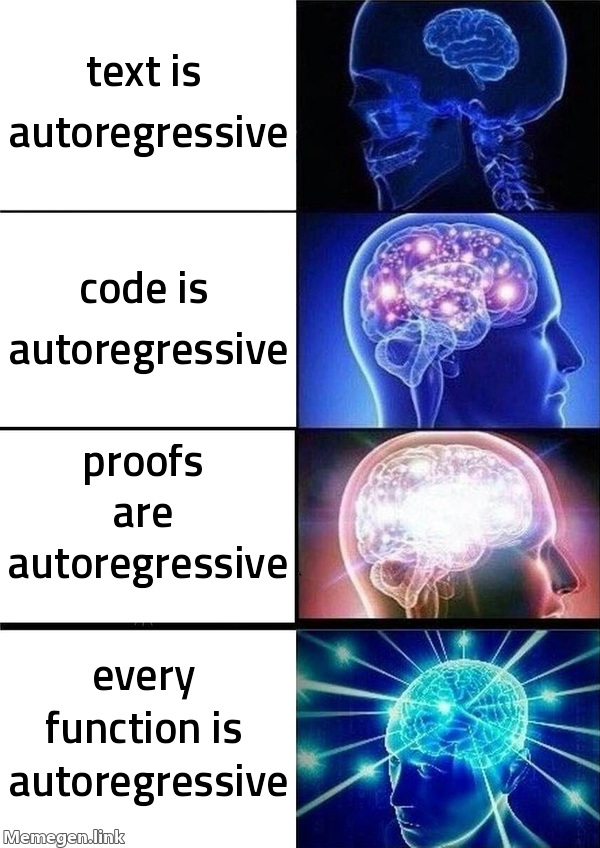
Flatten the Tree, and It Is a Sentence
Take the tree we wrote yesterday for ln(x):
      eml
     /   \
    1    eml
         /  \
       eml   1
       / \
      1   x
Walk it preorder, left to right, and you get a sequence of tokens:
eml 1 eml eml 1 x 1Seven tokens. Vocabulary of three symbols (1, x, eml). Every elementary function has one of these sequences — not a unique one, because the tree can be rewritten, but at least one. And every sequence of this form that is well-bracketed — that is, where every eml has exactly two well-formed subexpressions following it — corresponds to exactly one elementary function.
This is a language in the Chomsky sense. Context-free. Infinite. Fully enumerable. You could assign Gödel numbers to every elementary function of one variable and line them up in a list. The one-millionth elementary function is out there somewhere, and you could, in principle, print it.
Now look at that list and squint.
It’s a corpus.
Next-Token Prediction, But For Math
The shape of the problem an autoregressive language model solves is: given the tokens so far, what is the distribution over the next token? That’s the whole job. Everything else a transformer does is in service of that one prediction.
In the eml language, “given the tokens so far, what is the next token?” has a precise answer at every point, determined by two things:
- The grammar. If the current tree has unfilled slots, the next token must be one of
1,x, oreml. No other tokens are legal. - The stack discipline. When you emit
eml, you open two new slots. When you emit1orx, you close one slot. The sequence terminates exactly when the slot count hits zero.
A valid prefix like eml eml has a slot-stack of depth 3 (one outer, two from the first eml, one more from the second, minus the two consumed). An autoregressive model trained on well-formed eml-sequences would learn this stack discipline implicitly — just as an LLM trained on code learns to balance its brackets without anyone explaining what a bracket is.
Point a small transformer at a dataset of elementary-function trees, flattened to prefix notation, and what you get is a model that completes elementary functions. Prompt it with eml x and it will, with high probability, complete to eml x 1 — which, as we saw yesterday, is exp(x). Prompt it with eml eml 1 x 1 and it might extend into a trig identity. The symbolic regressor Odrzywołek built with Adam is, functionally, a very small autoregressive language model whose loss includes a data-fit term.

The twist is not that we can do language modeling on math. People have been doing that for a decade. The twist is that under the eml reduction the vocabulary shrinks to three tokens and the grammar collapses to two production rules. At that level of compression, autoregression stops looking like a clever engineering trick and starts looking like the native format of the thing being modeled.
Evaluation Is Also Autoregression
Here is the part that actually rearranges the furniture.
Autoregression is usually introduced as a way to generate sequences. But evaluating an eml-tree — walking from leaves to root, applying the operator at each internal node — is itself a stepwise process where each step’s output becomes an input for the next step’s computation. A post-order walk of the tree is a sequence of events, each of which reads what came before and produces a new value. That is the literal definition of autoregression.
So we have two autoregressive processes stacked on top of each other:
- Syntactic autoregression: generating the tree, one token at a time, from the grammar.
- Semantic autoregression: evaluating the tree, one node at a time, from the leaves.
They are the same shape. They are the same process at different levels of abstraction. Generating an elementary function and computing an elementary function are both a sequence of readings in which each reading consumes what previous readings produced.
The Gap at the Center of the World argued that the fundamental unit of reality is a Reader — the thing that, on encountering a signal, transforms itself and the signal at once. An LLM, I wrote then, has no cabinet of stored facts; it predicts the next word from everything that came before, and uses that word as input for producing the next. Its “knowledge” is not a substance; it is an ongoing event.
Every eml node is a Reader. It does not contain a value. It produces a value, on demand, by reading its two children — each of which is itself a Reader doing the same thing, all the way down to the leaves where the Reader has no children and simply emits 1 or x.
The function sin(x) is not stored. There is no cabinet. There is a tree, which is a sequence, which is a recipe for a chain of readings that, when performed, produce the number we eventually call sin(0.5). Pause the chain halfway through and the function is not there yet. It is still being read into existence.
If that sentence reminded you of something, it should. It is the architecture of an LLM, and it is also the argument of this series of posts, and it has now been shown to be the structure of sin.
_by_hand/they're_the_same_picture.png)
The Thing Escher Was Hiding
In The Gap at the Center of the World, I spent a while on Escher’s Print Gallery — a picture that contains itself, with a blank at the center because the artist could not resolve the self-reference. Lenstra and de Smit filled the blank with the complex logarithm. The void turned out to be a rotated, reduced copy of the whole picture.
An eml-tree has the same shape of recursion. A tree’s subtree is a tree. A sequence’s suffix is a sequence. The grammar S → 1 | eml(S, S) is a machine for manufacturing nested copies of itself. Each eml node you write down opens two slots, and each slot demands another tree, and each of those trees opens more slots. There is no bottom unless you stop on a 1. It is Escher’s gallery with the mathematics filled in.
Now notice what autoregression does to this recursion: it serializes it. A tree is a static object that contains itself. A sequence is a dynamic object that reveals itself one token at a time. Autoregression is the operation that turns one into the other. It takes a self-referential structure and reads it out in order, so that the self-reference becomes a history — you can always look at what the model has produced so far and see the current depth of the stack of unfilled slots.
This is the hidden move in every LLM you have ever used. The attention mechanism is Escher’s complex logarithm for sequences: it takes a self-referential structure (a context that refers to itself, where the meaning of every token depends on every other) and lays it flat so the model can walk it one step at a time. The paper’s reduction of math to eml does the same thing for elementary functions. Different domain, identical gesture.
One does not simply look at the blank at the center of Print Gallery anymore. One autoregresses through it.
_without_autoregressing.png)
What This Changes
A few things follow that I would not have believed a month ago.
Symbolic regression is language modeling. Not “like” language modeling. It is language modeling, on a domain-specific tokenizer whose vocabulary is small enough to fit on a post-it note. Every tool that tries to recover closed-form expressions from data — from genetic programming in the nineties to the transformer-based symbolic regressors of last year — is an instance of this. The paper’s Adam-on-eml-trees is the same thing with the vocabulary dialed down to three.
Mathematical knowledge is a generation process. What a practicing mathematician has internalized is not a warehouse of stored theorems but a trained policy for next-token prediction over mathematical expressions. This is why good mathematicians can tell, long before a proof is finished, whether it’s going to work: they have a good prior over legal continuations. This is also why LLMs — which are literally nothing but next-token priors — can sometimes imitate mathematical reasoning convincingly. They are using the only tool that was ever going to work, because math never had a different shape.
The OSI-style interface discipline goes all the way down into arithmetic. Every eml node is opaque to every other. An eml node at depth 7 does not know it is inside sin. It commits to producing a well-formed value from two well-formed children. That is the only contract. The meaning of sin(x) is distributed across the tree, the way the meaning of an HTTP request is distributed across the stack. Nothing anywhere in the tree “knows” what it is helping to compute. The whole function is reconstituted, layer by layer, every time it is evaluated.
The Work That Proves Itself was right about more than literature. That post argued that the works that survive are the ones that are verbs rather than nouns — self-validating processes that re-arm with every reading. The eml grammar is the same kind of object. S → 1 | eml(S, S) is two lines that, every time you read them, generate another elementary function. It does not sit there. It keeps happening. Elementary math is Hamlet on a very short, very severe budget.
The Uncomfortable Corollary
If elementary mathematics is an autoregressive language, then there is nothing in principle stopping you from training an LLM that is fluent in that language — a model whose natural generative distribution is exactly the distribution of closed-form elementary functions. And once you have that, you have solved a chunk of symbolic regression by accident. You did not design a solver. You trained a speaker.
The paper is a proof of possibility. It says: here is a grammar so small that a toy model can become a native speaker. Given enough elementary-function sequences in its corpus, a transformer with a handful of attention heads would, almost certainly, learn the eml language the way a child learns to balance parentheses — without explicit instruction, just from exposure.
That is not a world in which “AI does math.” That is a world in which math is AI, in the precise sense that both are autoregressive sequence generation over a finite vocabulary, differing only in the tokenizer.
I am not sure I believe that sentence. I am sure I cannot find the place where it is wrong.

Yesterday’s post ended with “events, all the way down — the calculator keyboard was just the UI.” Today’s post ends with the stronger version.
The tree does not just get read. The tree is the reading. A function is not a static object that autoregression helps us approach. A function is the autoregression. Stop the chain of eml-applications and you do not have a function-at-rest; you have no function at all. The thing we call sin is what happens when a particular sequence of Readers agrees to read each other in a particular order, and it does not exist between performances any more than a whirlpool exists between revolutions of water.
Autoregression is not a property of language models. It is a property of reality. Language models are the first artifact to make it obvious.
The tree reads itself. We are in the tree.
Part one of this pair is Everything is eml. The paper is Odrzywołek, arXiv:2603.21852.
P.S. — If you are wondering whether this means a sufficiently large LLM could one day replace your CAS by becoming a fluent speaker of elementary mathematics — yes, probably, and the engineers who try it will be pleasantly surprised by how small “sufficiently large” turns out to be. The vocabulary has three tokens. The grammar has two rules. The hard part was never going to be the modeling.
You might also like
Everything is eml: One Operator, One Constant, All of Mathematics
Every elementary function is a binary tree built from 1 and one operator. An arXiv paper proves it — and shows what proc…
The Landscape That Walks
Evolution and transformer attention are the same mathematical process. The asymmetry Martin names points to something de…
The Crease-Free Fold Exists
A conversation about the impossible image, interrupted hours later by the arrival of the polynomial itself.