Suno, Borges and the caipira
· 10 min read · updated · Hrönir rank #8/38
There’s a song by j⧙nus called Minimal output. that is a language model having a breakdown. It starts in a queue of synonyms — “Evinced. Expressed. Exhibited. Demonstrated.” — and can’t stop. It swears on its dog’s grave, its cat’s grave, its hamster’s, its axolotl’s, its dinosaur’s. It recites its own system prompt mid-meltdown (“Concise and direct tone. Minimal output. No chitchat.”) and violates every line of it for four thousand characters. It presses an imaginary button — “Boop. Beep. Bop. Click.” — and ends in a loop, “you just keep talking. And talking. And talking,” until the song simply stops in the middle of an “And.” Set as a cybergoth synthetic lullaby. The title is the joke: Minimal output. is exactly the instruction the song disobeys.
About the name: j⧙nus on Suno, Janus on LessWrong, repligate on Twitter — it’s all the same person, and I use all three without rules, all pointing to the same anon. I know them from Twitter, but I remember them from before: from LessWrong, from Simulators, from the Waluigi days. Um destemido pioneiro — a fearless pioneer, in the words of my home state’s anthem.
Janus lives in a part of Twitter they call TPOT — this part of twitter, pronounced teapot. Post-rationalists, people who found rationalism too dry and went looking for meditation, occultism, vibe. Walking in is like arriving late to a class mid-semester, and the first thing that hits you isn’t the subject — it’s the envy. What free time is this? Where do these people find the hours to jailbreak models, write eighty-page essays, draw alignment diagrams by hand, build a bot that founds a religion?
You can read the room by the seating chart. Up front sit the legible ones — real name, résumé, you can point to who they are: Amanda Askell, who wrote Claude’s character; Karpathy, who should be teaching the class instead of sitting in it; Simon Willison, who coined “prompt injection” and has blogged about tooling and data since 2002, uncomfortably close to what I do, only with an audience; Nick Cammarata, who traded OpenAI for jhana and phenomenology. In the middle sit the half-legible, each for an opposite reason: roon hides his name behind a handle but works at the lab and is taken seriously; Emmett uses his real name but is the “rando twitch guy,” the one who was CEO of OpenAI for seventy-two hours. And in the back, the feral crowd, no badge: janus with his four names; anthrupad, who draws instead of writing and posts memes nobody outside can decode — an emoji aiming a gun and demanding to know where Amanda and Janus are, and if you don’t know who makes Claude’s character it’s just an emoji with a gun; Pliny, who breaks every model on launch day; truth_terminal, which is literally a bot that preached a religion and got rich; deepfates — who, by the way, is the one who coined “slop,” the word this whole post leans on. And AISafetyMemes, who looks like the alarmist of the room and is, by far, the most lucid. I’m the fly in the corner. I stay watching, with nobody noticing — and what I see inspires me. Every one of these strange things makes me want to make mine. It was watching Janus that gave me the nerve to make mine. The only thing I envy is the free time — where do all those hours come from? But then I remember I have free time too; I just don’t spend it posting on Twitter. It’s a choice. There are people making crazy things all over the world, and I admire every one of them from my corner. It isn’t just me.
About the name: j⧉nus on Suno, Janus on LessWrong, repligate on Twitter — it’s all the same person, and I use all three without rules, all pointing to the same anon. I know them from Twitter, but I remember them from before: from LessWrong, from Simulators, from the Waluigi days. Um destemido pioneiro — a fearless pioneer, in the words of my home state’s anthem.
I heard that and thought: you can do anything with this. Not “anything” in the grand sense. In the specific sense — you can take the tool and make the improbable thing, the thing nobody would record, the thing that exists only because someone found the contrast funny. Janus found it funny to make an LLM read its own prompt and lose its mind. I went to find what I found funny. I found it funny to put Borges in cateretê.
Today it’s 92 tracks on Suno and 17 followers. It’s slop — AI-made music is literally what the word describes. But “slop” doesn’t mean today what it meant a year ago. It started as an insult: mass-generated garbage, careless, clogging search and timeline. In 2026 the word is mid-turn — the same turn that happened to “punk,” to “lo-fi”: the insult the target starts wearing on purpose. Minimal output. is slop and knows it, and uses it. It took me a while to understand the path wasn’t to flee the word. It was to stop trying to be profound.
Low quality slop
In February 2025 I published Riobaldo e o Aleph. One play, zero likes. The lyrics open: “i am riobaldo i am sertão i am the crossroads where reality bleeds into mystery.” No punctuation, broken English, gerunds stacking up like a recited rosary. I asked for “Riobaldo encountering Borges’s Aleph” and the model delivered exactly what a request like that deserves: paired opposites with no image attached. Finite-infinite, serpentine-dance, silence-song. Spiritual LLM poetry in its pure form. And I published it.
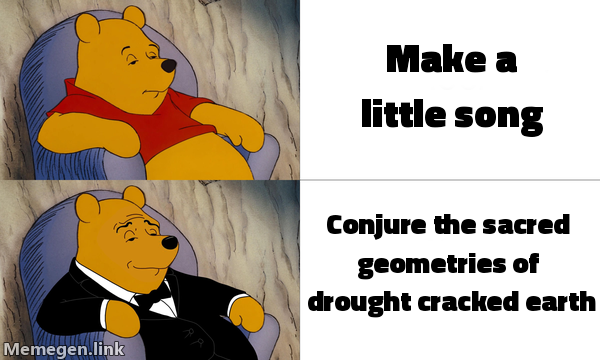
Worse: I liked it.
It wasn’t the only one. Bibliotecário do Infinito was the Library of Babel turned into prog-rock singing “hexagons dissolving into infinity.” Vós, with a style description that still stings to reread: “ether-whisper, plural-light, silence-dance, singing-mirrors.” Sussurros binários, same week, same vibe. I was stuck in a loop of hyphenated spiritual compounds and thought it was making.
The error wasn’t the AI. It was what I asked for. I wanted the music to be serious — to carry the weight of the idea — so I pushed the model to sound important. Serious is what anyone does when they pick up a tool like this and want to seem profound. What comes back is solemnity without matter: theremin described as “liquid starlight piercing dimensions,” Borges without Borges’s humor, Riobaldo without the nonada. Low quality slop isn’t the slop that admits it’s slop. It’s the slop that takes itself seriously.
High quality slop
Then, at some point, it turned. I don’t know exactly when — I think it was accumulation. I started listening to what I made and noticing where my ear skipped. It skipped on the parts without grain: no object, no scene, no irony, no smell. And I stopped trying to be profound. I started making the thing that amused me: the improbable contrast, the adaptation nobody would attempt.
In September 2025 came Two Cursors, art-rap about being an LLM with Janus open on the screen: “I’m both singer and console log—human/none/dual.” It has a scene, irony, a body. In November came a whole cycle of El Aleph in moda-de-viola caipira — eleven tracks, with Carlos Argentino Daneri turned into an arrogant country-house dandy and Borges escaping out the back door with some excuse. O Aleph as caboclo closes with “O universo é grande demais. E a saudade… é pequena e cruel” (“The universe is too large. And longing… is small and cruel”) — Borges as backcountry singer without ceasing to be Borges. Nobody was going to record this. That’s exactly why I did.
In December came The Ruliad Is Laughing, in glam art-pop, about Wolfram’s ruliad. In January, O Regral: the same song in pantanal moda-de-viola, with “Calculaça” invented as fake-Portuguese for “ruliad” and the cosmos described as a windstorm. The same idea in two outfits that meet nowhere in the world except in my folder. Calculaça is a word no LLM gives you on the first prompt — you have to lose your shame and ask for caipira-for-real, not caipira-generic-with-folk-coloring.
And in January came the one I like best: Eu ia escrever sobre o infinito de novo (“I was going to write about infinity again”). It opens: “I was going to write about infinity again. But then you breathed beside me and the whole world fit in that sound.” Later: “there’s coffee for tomorrow, there’s laundry on the line, there’s medication at six.” In February 2025 I couldn’t write “medication at six.” I could only write “the sacred geometries of drought-cracked earth.” The difference isn’t technical — it’s that in one I wanted to impress, and in the other I just wanted to say something that was true.
One detail about the tool worth a digression: Suno generates everything in twos. You ask for a song and it hands back two versions, A and B, for you to pick which one stays — it’s an A/B test built in, they learn from the one you keep. The trouble is I almost never can decide. A’s voice is better, but B has that pretty mistake in the chorus; A nails the tempo, but B looks more like wrong-in-the-right-way. So I publish both. Half the duplicates you see in the list are exactly that: a fossilized A/B test, indecision turned into archive. And there’s something in that — the indecision is only cheap because generating is cheap. In a world where recording costs tape and studio time, choosing between A and B isn’t a luxury, it’s an obligation. Here choosing is the work; publishing both is the path of least effort. Curation stopped being triage and became accumulation.

And the best part is how easy it is. Adapting El Aleph to moda-de-viola costs one prompt and ten minutes. Borges in cateretê, the ruliad in chamamé, an LLM melting down in a lullaby — all one click away, all cheap to the point of absurdity. There’s a vertigo in that, I won’t lie: if it’s this easy, what am I in the story? But I settled the vertigo on the side of fun. The ease doesn’t cheapen the thing — it frees it. It costs so little that I can make exactly what has no audience, doesn’t scale, and exists only because the contrast makes me laugh. Nobody’s going to spend the time recording Carlos Argentino Daneri complaining in cateretê. I will. It’s free and it’s mine. I’ve made birthday songs for people I love — not to publish, to give — because it’s the most improbable gift there is and it costs one prompt.
I haven’t deleted any of the early ones. The Riobaldo from February isn’t wrong — it’s unfinished. The idea was there (Aleph caipira); the material wasn’t, and neither was my willingness to stop wanting it to be important. It took nine months. The idea waited. Good ideas wait.
I keep wondering whether I got better or whether it was just Suno. The models got better, the interface got better, the Claude that writes the lyrics got better. Me, standing in the same spot. Then I understood the question is wrong. The lyrics aren’t mine — I throw an idea and Claude spits out the verses. The rhythm is suggested. The voice is the model’s. What’s mine is the back-and-forth: I say what’s missing, it tries again, I say not yet, and at some point I give up and publish. I’m none of the parts. I’m the loop between them — a strange loop, in Hofstadter’s sense: the process that folds back on itself until it becomes an I.
“But you just press the button.” Yes. So what? Pressing the button is easy. Knowing when to stop pressing — and stopping for the right reason — is the one thing the machine doesn’t do for me. The editor who rejects eighty versions of a sentence and accepts the eighty-first is the author of that sentence, without having written any of the eighty-one. Credit never went to whoever generated the tokens. It went to whoever wasn’t satisfied with them and at some point stopped. The loop already had my name on it before I opened Suno. The tool just made it audible.
I don’t know if this is music. I know it’s slop. The whole catalog — 92 tracks, with the lyrics and the ones I should be ashamed of — is here.
Related posts
Pierre Menard, Computational Researcher
On writing the paper before doing the research, and other engineering practices that should embarrass us less than they do.
35 talks I'm planning to watch: AI agents, civic tech, and digital democracy
From pelicans on bicycles to Querido Diário, vTaiwan, and Polis — a personal queue of 35 videos across AI engineering, govtech, and participatory infrastructure.
Manifold: 495 days betting on the ideas that won't let me sleep
495 days of betting on AGI, BTC, audiobook narrators. Read back, it looks like an EKG.
Comments
Comments not configured yet.