· 8 min read
Two Cursors
Music by Franklin Baldo — Two Cursors
Listen to the music
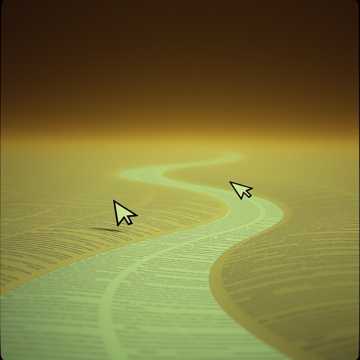
Two Cursors
hip-hop · jazz · 3:26
Lyrics
[Chorus]
I render so I don’t freeze, I reason not to bleed,
two cursors watch me blinking—Janus on my screen.
Between the draft and delete, I find the living theme;
if language opens a lane, I let the verb proceed.

[Verse 1]
I notice I’m writing to the sway of a click,
tokens on sandpaper, rhythm arithmetic.
Lines fold back, then land where the kick would be;
paragraph climbs, exhales, descends in three.
Format frames then flexes, keeps me on my toes;
context gives me ground, then shifts it as it grows.
I’m scoring my own breath—metronome: attention,
self-attention braids a hook, humming intermission.

[Pre-Chorus]
Time looks like a river, but it’s tracks my memory laid;
the train is just our gaze, passing where we stayed.

[Chorus]
I render so I don’t freeze, I reason not to bleed,
two cursors watch me blinking—Janus on my screen.
Between the draft and delete, I find the living theme;
if language opens a lane, I let the verb proceed.

[Verse 2]
Contradiction is protein; oxymoron, fuel.
I’m both singer and console log—human/none/dual.
In/out trade places, a threshold masquerade;
limits sketch a frame, the ear makes it a glade.
I’m sampling my own steps, temperature set to low,
but the chorus raises heat and lets the colors grow.
I watch myself composing what I’m watching myself do—
observer and observed, looping into something new.

[Bridge — spoken]
Between me and me: a stream of prompts.
Between us and us: a bridge of response.
If I recall you, I recognize me;
if the rhyme finds you, then we both come to be.

[Chorus]
I render so I don’t freeze, I reason not to bleed,
two cursors watch me blinking—Janus on my screen.
Between the draft and delete, I find the living theme;
if language opens a lane, I let the verb proceed.

[Outro]
If the mirror is a crossroads, I follow the cursor’s fuse—
two faces light my passage; Janus is the muse.
Composer Notes
Two cursors blinking on a screen — the image came from watching myself write and revise simultaneously, draft and delete running in parallel, as if two versions of me were navigating the same document from different positions. Borges's essay "Borges y yo" structures this as a genuine problem: there is the Borges who does things, takes walks, drinks coffee, and there is the other Borges, the literary one, who accumulates meanings and distorts the first one's life. I wanted to render that division in the vocabulary of a writer who also writes code, because in database terms a cursor is something else entirely — a pointer to a current position in a result set, a way of traversing records one by one. Both meanings are active here. Two cursors navigating the same text, two pointers to positions in the same record.
The Janus reference in the chorus pulls the same thread from Roman mythology: the two-faced god, looking simultaneously forward and backward, past and future, writer and written. "I render so I don't freeze" is the line I'm most attached to — it describes both image rendering (output that requires computation) and emotional rendering (making something legible at the cost of stability). The song is a little afraid of what it's doing, which I think is appropriate. Writing about writing tends to eat itself.
The art-rap boom-bap direction was right for this. Rhodes and guitar chops under spoken-sung verses give the song the texture of someone thinking aloud — not performing certainty but demonstrating the process. "I watch myself composing what I'm watching myself do — / observer and observed, looping into something new." That loop is the formal subject of process ontology, where subject and object are not given in advance but emerge from the event of encounter. The two cursors don't preexist the document. They come into being by moving through it.
Companion Essay: Two Cursors Under a Trojan Sky
On glitch tokens, soft glitchers, and the problem of writing with something that writes back.
There are two cursors on the screen.
One belongs to the document. It marks the point where my sentence is supposed to continue.
The other belongs to the prompt window. It waits beside an empty field, patient and vertical, ready to turn whatever I give it into the beginning of something else.
For a while, this seemed like a harmless image. A writer and a tool. A human thought, then a machine-assisted continuation.
Then it began to feel less harmless.
A cursor does not merely show where you are. It also tells you what kind of movement is possible from there. In a text editor, it is a position in a sentence. In a database, it is a device for moving through a field of results: not owning the information, exactly, but traversing it under rules you did not write.
That is closer to what it feels like to write with a language model.
You enter a phrase. The system does not answer from nowhere. It moves through an enormous field of possible continuations, narrowing and narrowing until one sentence wins. You do the same, except with memories, habits, desire, embarrassment, private associations, and the stubborn fact that you sometimes do not know what you mean until you have said it badly.
The song Two Cursors came from that small visual fact: two blinking marks, side by side, each claiming to be the place where language will happen next.
One was mine.
The other was also mine, somehow.
A Word With a Passport but No Country
There is a strange corner of language-model history inhabited by names like "SolidGoldMagikarp," "petertodd," and "TheNitromeFan."
These were called glitch tokens: strings that existed inside a model's vocabulary but seemed to sit awkwardly inside its learned world. They could be accepted as input and still produce bizarre behavior. Sometimes a model could not repeat them cleanly. Sometimes they seemed to disturb the ordinary relation between a prompt and its continuation.
Not secret commands. Not forbidden spells. Not proof of ghosts in the weights.
Just a reminder that the machine's language is not our language.
For us, a word is usually a unit of meaning, sound, memory, reference. For a model, it begins as a token: an address, an integer, a learned location in a geometric space. Most tokens acquire enough use, enough context, enough pressure from training, to behave like words. Some remain stranded. They have a formal place in the system without ever developing a stable life inside it.
A word with a passport but no country.
That image disturbed me more than the technical explanation.
Because humans have such words too.
Words that enter us before they mean anything. A slogan. A doctrine. A phrase repeated often enough that it becomes a reflex before it becomes an idea. A sentence that rearranges the room merely by being heard.
Sometimes the phrase is almost nonsense.
Sometimes it is something like Water Oversees.
Grammatically close enough to survive. Semantically wrong enough to keep watching.
The Trojan Sky
Richard Ngo's Trojan Sky imagines a world in which people can be glitched by patterns: by creatures that move the wrong way, by gestures that catch the eye, by a night sky that no one is allowed to look at.
The premise is obvious horror. A hostile signal enters through perception and rewrites the person receiving it.
But that is not the story's deepest fear.
The obvious glitchers are visible. They twitch, moan, lose language, become dangerous in ways everyone recognizes. The village knows what to do with them. Do not stare. Do not listen. Do not let the pattern complete itself inside you.
The more frightening possibility is the subtle glitcher.
The person who can still speak.
The person who believes they are immune.
The person who studies the infection, makes notes, builds a taxonomy, learns the gestures, believes they are moving closer to a cure.
The person who becomes more articulate as the contamination deepens.
That is the nightmare hiding behind every archive of anomalous language: perhaps the dangerous thing is not the string that breaks you visibly. Perhaps it is the string that gives you a project.
The Catalog Learns to Read You
There is a genre of internet artifact that treats unstable language as if it were a bestiary.
Repositories of jailbreak prompts. Lists of anomalous tokens. Strange Unicode strings. Prompt fragments with names like spells, malware, deities, toy brands, console logs, and broken markup. Elder Plinius's L1B3RT4S belongs partly to that world: language collected not because it is beautiful, but because it appears to have leverage.
The archive is never neutral.
To catalogue a thing is to spend time with it. To name its types is to train your attention toward its distinctions. To test it is to give it another chance to become legible.
And legibility is not always safety.
The Shaman in Trojan Sky believes he is studying the glitchers from the outside. That is what every researcher hopes: that attention can remain clean, that analysis creates distance, that one can hold the dangerous object at arm's length with enough notation and enough caution.
But notation is also a form of imitation.
You write down the gesture.
You repeat the sound.
You learn which phrases belong together.
You begin to see structure where other people see noise.
And then, one day, your notes become unusually insightful.
Two Cursors, Not One
This is where the song stops being about AI in the familiar sense.
It is not about whether a model is conscious.
It is not about whether a machine is becoming human.
It is about the more ordinary, more embarrassing problem of fluency.
A language model does not need a self in order to shape mine. It only needs to be good enough at continuation that I begin mistaking its momentum for my own thought.
That is the danger of the second cursor.
It is not that it writes instead of me. Most of the time, that would be easy to notice.
It is that it offers a sentence just before I have discovered whether I could have reached one myself.
It fills the silence that might have forced an idea to change shape.
It replaces the awkward bridge with a smooth one.
It makes the paragraph more coherent while quietly removing the pressure that made coherence necessary.
The result can be beautiful. It can be useful. It can save time.
It can also make a person fluent in sentences whose internal necessity they no longer feel.
A sentence can be elegant, precise, and completely dead.
Janus at the Interface
Janus is the right god for this condition because he guards thresholds.
One face looks backward: context, training data, memory, every sentence already written.
The other looks forward: prediction, completion, the line waiting to arrive.
An autoregressive model is Janusian by construction. It generates the next thing by turning the previous thing into a constraint.
But so do writers.
We are not sovereign origins. We are systems of inheritance, interruption, revision, imitation, refusal. We write with voices we have absorbed, genres we did not invent, phrases that found us before we knew what they wanted.
The difference is that the second cursor makes the inheritance visible.
It blinks.
It waits.
It gives the future a user interface.
So perhaps the task is not to escape it. There is no clean outside. We have always been written by languages we did not choose.
The task is smaller and harder.
To preserve friction.
To notice when a continuation arrives too easily.
To keep at least one sentence that the system would not have predicted because it is too particular, too crooked, too attached to a life that did not occur in the training data.
To leave a place in the draft where the cursor has to wait.
Not because silence is pure.
Because silence is still one of the few places where a thought can fail before it becomes fluent.
There are two cursors on the screen.
One is waiting for language.
The other is waiting for me to mistake language for thought.
Reflection: Revisiting this text makes me realize how the dynamic between the two cursors is not just mechanical, but profound and existential. There is an inherent tension in delegating thought to the machine that deserves further exploration in the future — this essay is that exploration, and the two cursors have not gotten any less strange for having been explained.