· 2 min read
Escherian Sunrise (with Gödel)
Music by Franklin Baldo — Escherian Sunrise (with Gödel)
Listen to the music
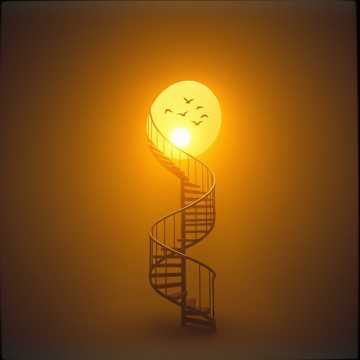
Escherian Sunrise (with Gödel)
folk · acústico · 3:31
Lyrics
[Intro — 4 bars]
(soft piano loop, reverse swell)
the drawing wakes / the stone remembers

[Verse 1]
The architect dreamed stone and light,
Of stairs that circle into dawn,
Where up meets down in braided height
And lost returns to what is gone.

Hands test the air for solid ground,
A railing where no edges stay;
He maps a loop that wraps around—
Tomorrow's yesterday.

[Pre-Chorus]
Hold your breath: the blueprint bends,
Frames unframe the view again—

[Chorus]
The sun rose, falling through the sky,
The shadows climbed instead of fell;
Birds turned to fish and swam on high—
No single dawn could ever tell.

[Verse 2]
Waterfalls marched up the walls,
Columns twisted left and right;
Tiles tessellated moving halls,
Darkness flowering into light.

Steps ascend to their own base,
Courtyards echo endless tread;
Every path becomes a place
You haven't left—and yet.

[Pre-Chorus]
Count to four; the grid miscounts—
Paradox in small amounts—

[Chorus]
The sun rose, falling through the sky,
The shadows climbed instead of fell;
Birds turned to fish and swam on high—
No single dawn could ever tell.

[Bridge — Gödel]
A logician came at break of day,
With careful symbols in his hand:
“I’ll prove the sunrise stays this way”—
He couldn’t make the sunrise stand.

“For systems built on axioms pure,
There live true things they can’t approve;
This line declares—inside the frame—
It cannot be proved.”

(whispered answer)
incomplete, incomplete—

[Post-Bridge Refrain]
Some truths move where proofs can’t fly—
(incomplete—) watch the morning self-apply—

[Chorus]
The sun rose, falling through the sky,
The shadows climbed instead of fell;
Birds turned to fish and swam on high—
No single dawn could ever tell.

[Verse 3]
“Come walk,” the dreamer softly said,
“Where endings pull the first step near;
Let logic loosen one thin thread—
The whole design appears.”

Theorems taste their own bright tail,
Ladders lean on what they prove;
Sunrise finds its resting veil
Right where numbers cannot move.

[Final Chorus — lift]
The sun rose, falling through the sky,
The shadows climbed instead of fell;
Birds turned to fish and swam on high—
What’s true exceeds what we can tell.

[Outro]
(lithograph hush)
reason bows, the light goes on
Composer Notes
Escher and Gödel appear together in Hofstadter's book, but what interests me isn't his thesis about consciousness as strange loop — it's the underlying structure both of them reveal: the impossibility of closed systems fully grounding themselves. Escher saw it through image: staircases that ascend and descend simultaneously, hands drawing each other into being. Gödel saw it through symbol: inside any formal system powerful enough to express basic arithmetic, there are true propositions the system cannot prove. What drew me was placing both in the same dawn — the same moment when light begins, when form emerges from the indistinct.
The choice of rustic English folk ballad in D Dorian — lute, wooden flute, small drum, tambourine — was a wager. I wanted Gödel in the bridge to sound like a troubadour, not a logician. "I'll prove the sunrise stays this way — / He couldn't make the sunrise stand." Incompleteness as humility rather than defeat. Suno understood the tone and delivered something that sounds like a medieval ballad about reason meeting its limits, which is exactly what it is. I admit I wasn't expecting the genre to carry the argument so well.
The line I care most about is the bridge's whisper: "incomplete, incomplete." There's a specific beauty in the incompleteness theorems that most discussions about them miss: Gödel doesn't say we cannot know. He says that any sufficiently rich system of knowledge carries within itself statements that exceed its own capacity for verification. For the process ontology I work with in Events All the Way Down, this is consoling rather than paralyzing — it means the map never coincides with the territory, and that this is a property of real territories, not a defect in maps. The final line — "reason bows, the light goes on" — is the position I've arrived at, at least for now.