· 6 min read
Borges and I
Music by Franklin Baldo — Borges and I, with three other musical versions of the same text (greentext, glitch rap)
Listen to the music
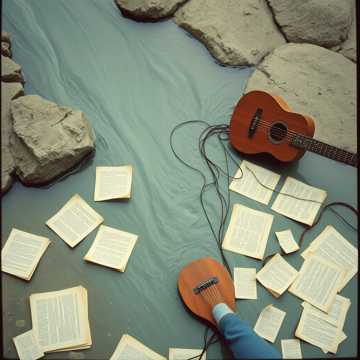
Borges and I
spoken word · folk · 2:57
> be me Borges (2025 — greentext version)
indie · spoken word · 3:08
> be me Borges (2026 — new version)
indie · spoken word · 6:53
Borges and me (glitch rap)
hip-hop · glitch · 2:19
This post gathers four musical settings of the same text — "Borges e eu" ("Borges y yo"), the two-page essay in which Borges stages, without resolving, the split between the self who lives and the self who writes. The first three were composed between October 2025 and June 2026, each as its own post; the fourth arrived in July 2026, nearly a year later, when I asked Suno to try the 2025 greentext lyrics again. Rather than publish the new take as another orphaned post, I folded all four together here. Given that the essay is precisely about a self that multiplies into versions it no longer controls, that felt like the right move.
Borges e eu (classical guitar + bandoneon, PT)
Lyrics
Ao outro, a Borges, é que sucedem as coisas.
Eu caminho por Buenos Aires e me demoro, talvez já mecanicamente,
para olhar o arco de um vestíbulo e o portão gradeado;

de Borges tenho notícias pelo correio
e vejo seu nome em uma lista tríplice de professores ou em um dicionário biográfico.

Agradam-me os relógios de areia, os mapas, a tipografia do século dezoito, as etimologias, o gosto do café e a prosa de Stevenson;
o outro compartilha essas preferências,
mas de um modo vaidoso que as transforma em atributos de um ator.

Seria exagerado afirmar que nossa relação é hostil;
eu vivo,
eu me deixo viver,
para que Borges possa tramar sua literatura,
e essa literatura me justifica.

Não me custa nada confessar que alcançou certas páginas válidas,
mas estas páginas não podem salvar-me,
talvez porque o bom já não seja de ninguém,
nem mesmo do outro,
mas da linguagem ou da tradição.

Além disso,
eu estou destinado a perder-me,
definitivamente,
e só algum instante de mim poderá sobreviver no outro.

Pouco a pouco vou cedendo-lhe tudo,
embora conheça seu perverso costume de falsear e magnificar.

Spinoza entendeu que todas as coisas querem perseverar em seu ser;
a pedra eternamente quer ser pedra e o tigre um tigre.
Eu permanecerei em Borges, não em mim
(se é que sou alguém),
mas me reconheço menos em seus livros do que em muitos outros
ou do que no laborioso rasqueado de uma guitarra.

Há alguns anos tentei livrar-me dele
e passei das mitologias do arrabalde aos jogos com o tempo e com o infinito,
mas esses jogos agora são de Borges
e terei que imaginar outras coisas.

Assim minha vida é uma fuga
e tudo eu perco e tudo é do esquecimento,
ou do outro.

Não sei qual dos dois escreve esta página.
Composer Notes
This text has followed me for more than fifteen years. "Borges y yo" — here rendered in its Portuguese translation, as that was the version closest to me — is barely a page long, and it resolves, or rather stages without resolving, a tension that anyone who writes knows in some form: what belongs to the public author and what belongs to whoever wakes up in the morning not yet knowing what they'll think. Borges names this with a precision that unsettles me. "I live, I let myself live, so that Borges may contrive his literature, and this literature justifies me." Justifies, not liberates. There's a submission there that's too honest to be comfortable.
Setting the essay in Portuguese with classical guitar and bandoneon was an attempt to return to the text the accent of Buenos Aires without erasing it — to keep the geographical distance, the Spanish pressing through the translation. Suno captured the Argentine intonation I asked for. The result has the quality of something read aloud to oneself at three in the morning, not for an audience. That seemed right.
What moves me most in this essay, and what makes it different from a text about creativity or authorial identity, is the final sentence: "I do not know which of us has written this page." Borges leaves the question unanswered not out of modesty but because the question has no answer — because the distinction between the self that lives and the self that writes may itself be a product of writing. I carry a version of this problem in my own work. Events All the Way Down exists because someone wakes up and takes notes, but the one who takes notes, under the process ontology I defend there, is not quite the same someone who will wake up tomorrow. Borges arrived at the same threshold by other paths, with the elegance of someone who didn't need process ontology to get there. This distinction resonates uniquely when considering how identity fragments under the weight of one's work. The tension Borges describes reflects the ongoing struggle between raw experience and its polished representation, challenging the reader to question whether we are the authors of our own narratives or merely vehicles for a language that transcends us.
Other versions
> be me Borges (2025 — greentext version)
Lyrics
> be me
> walk around buenos aires
> stop to look at archways and iron gates
> probably just force of habit at this point

> there's this other guy, also me
> Borges
> he gets all the mail
> his name shows up on professor lists
> sees himself in biographical dictionaries

> we both like the same stuff
> hourglasses, old maps, eighteenth century fonts
> etymology, coffee, stevenson's prose
> but when he likes them it's performative
> like an actor doing a bit

> my face when I live my life so Borges can write his literature
> his literature is supposedly my justification for existing
> he's written some decent pages, not gonna lie
> but those pages can't save me
> the good stuff belongs to language itself, not to either of us

> eventually I'm gonna fade away completely
> only some moment of me will survive in Borges
> slowly giving him everything
> he has this annoying habit of distorting and exaggerating everything

> spinoza said all things want to keep being themselves
> rocks want to be rocks, tigers want to be tigers
> I'll remain in Borges, not in myself
> if I even am someone

> but I recognize myself less in his books
> than in some random guitar strumming

> tried to escape him a few years back
> moved from neighborhood myths to games with time and infinity
> now those games belong to Borges too
> gotta think up new things
> my whole life is just running away

> losing everything
> everything goes to oblivion or to Borges
> don't even know which one of us is writing this
> my face when
Composer Notes
"Borges and I" is one of the shortest and most unsolvable texts Borges wrote — two pages about the impossibility of being simultaneously the subject who lives and the writer who transforms that life into work. I wanted to make a version that rendered visible what the text feels but does not declare: the exasperation, the crooked humor, the absurdity of discovering that your identity has been outsourced to a name that appears in biographical dictionaries.
The greentext format — the imageboard convention of > be me — seemed like the right vehicle. It has the same structure as the original text: fragmented, laconic first person that refuses pathos but is full of content. And it has that specific irony of someone documenting a ridiculous situation while living inside it. My face when is the modern equivalent of "I do not know which of the two writes this page."
Suno interpreted the request for bandoneon and lo-fi indie in a way that surprised me — it came out more melancholic than I expected, almost devotional. Not exactly what I asked for. But perhaps it's what the text asked for. The last line — "don't even know which one of us is writing this" — landed with a reverberation I hadn't planned. Sometimes the instrument knows before the musician does.
> be me Borges (2026 — new version)
Lyrics
be me

walking around buenos aires
stopping for archways
iron gates
shadows on old buildings

probably force of habit

probably collecting details
for someone else

[Verse 1]

there's this other guy

also me

Borges

he gets all the mail

his name appears
on envelopes
professor lists
biographical dictionaries

people study his childhood
his influences
his recurring themes

I see myself
in shop windows
for half a second
before the angle changes

he has my face
more or less

my memories
more or less

my name
completely

[Anti-Chorus]

my face when
I live my life
so Borges can write his literature

my face when
he gets the name
and I get the weather

my face when
I walk through buenos aires

and he gets buenos aires

[Verse 2]

we like the same things

hourglasses
old maps
eighteenth century fonts

etymology
coffee
Stevenson's prose

but when I like them
I think I actually like them

when Borges likes them
it feels performative

like an actor
doing a very convincing bit
about being me

I give him a courtyard
a knife
a sentence overheard in a café

he adds mirrors
tigers
infinity
a dead theologian

suddenly it's literature

not gonna lie
some of the pages are good

this is part of the problem

[Anti-Chorus]

my face when
the literature is beautiful

but it still cannot save me

my face when
the good lines belong to language

not to him
not to me

language gets the custody

[Verse 3]

eventually
I'll fade away completely

maybe one moment survives
inside Borges

a morning
a fear
rain against one window

he'll keep it

then distort it
and exaggerate it

I give him an afternoon

he returns it
as a labyrinth

I give him a dream

he puts another dream inside it
and now nobody can leave

[Anti-Chorus]

my face when
I slowly give him everything

my face when
he turns my life
into evidence that he existed

my face when
I become a source

the citation outlives the witness

[Verse 4]

Spinoza said
all things want
to keep being themselves

rocks remain rocks

tigers remain tigers

I'm paraphrasing

Borges would know
the exact wording

Borges always knows
the exact wording

that's another thing
he stole

I also want
to remain myself

apparently

but I'll remain in Borges
not in myself

assuming there is a myself

which feels
increasingly optimistic

sometimes I think
I am only the part of Borges
that gets tired

the part that walks home

the part that forgets quotations

the part that answers the door

[Anti-Chorus]

my face when
the tiger remains a tiger

the stone remains a stone

and I remain
a paragraph
in Borges

my face when
I recognize myself less
in everything he wrote

than in some random guitar
strumming through a wall

[Verse 5]

a few years ago
I tried to escape him

left behind
neighborhood myths
dusty courtyards
men with knives

I moved on
to games with time

infinite libraries

people dreaming other people

the universe
as one sentence
misremembering itself

new territory

or so I thought

then those things
became Borges too

of course they did

now time belongs to Borges

infinity belongs to Borges

mirrors belong to Borges

there is probably
a Borges copyright claim
on eternity

[Bridge]

so I think up new things

I keep moving

but he arrives first

already waiting
inside the title

every road I take
to escape him

becomes another road
people call typically Borges

my whole life
is running from the author

who turns the escape
into style

[Final Anti-Chorus]

my face when
I invent a new world

and Borges gets the credit

my face when
I try to disappear

and disappearance becomes
a recurring motif

my face when
he gets the metaphor

and I get older

[Outro — whispered]

losing everything

everything goes
to oblivion

or to Borges

oblivion
or Borges

at least oblivion
doesn't exaggerate

be me

walking around buenos aires

hear a guitar
somewhere nearby

for one second
I recognize myself

not in the books
not in the name
not in the mirrors

just in the sound

then Borges hears it too

and now it belongs to him

probably

I don't know

I don't even know
which one of us
is writing this

my face when
Composer Notes
I asked Suno to try again, almost a year after the first greentext version, without changing the original prompt — I just wanted to see what a different model would do with the same idea. Chirp-fenix came back with a track nearly four times longer: where the 2025 version had five short stanzas and an implied chorus, this one has five full verses, an anti-chorus that repeats and degrades with every return, a bridge, and a whispered outro. "My face when," which used to be punctuation, became structure — the anti-chorus organizes the entire song, almost liturgical from sheer repetition.
What interested me most was what the model added without my asking: "the citation outlives the witness," "there is probably a Borges copyright claim on eternity," "disappearance becomes a recurring motif." These aren't ideas I wrote into the first version — they're elaborations the act of re-recording itself produced, as if the text kept writing itself between one generation and the next. It's almost too on the nose for what "Borges and I" describes: I gave Suno a lyric, it gave back something else, distorted and expanded, and now I don't know which of the two versions is the original. The new version's last line — "I don't even know which one of us is writing this" — didn't change a single word from the first. It just got truer.
Borges and me (glitch rap)
Lyrics
To the other, to Borges, things happen.
I walk through Buenos Aires and linger, perhaps mechanically already,
to look at the arch of a vestibule and the grated gate;

I get news of Borges by mail
and see his name on a triple list of professors or in a biographical dictionary.

I like hourglasses, maps, the typography of the eighteenth century, etymologies, the taste of coffee, and Stevenson's prose;
the other shares these preferences,
but in a vain way that turns them into attributes of an actor.

It would be excessive to state that our relationship is hostile;
I live,
I let myself live,
so that Borges may plot his literature,
and that literature justifies me.

It costs me nothing to confess that he has achieved certain valid pages,
but these pages cannot save me,
perhaps because the good no longer belongs to anyone,
not even to the other,
but to language or tradition.

Furthermore,
I am destined to be lost,
definitively,
and only some instant of me may survive in the other.

Little by little I am yielding everything to him,
although I know his perverse habit of falsifying and magnifying.

Spinoza understood that all things desire to persevere in their being;
the stone eternally wishes to be stone and the tiger a tiger.
I shall remain in Borges, not in myself
(if I am someone),
but I recognize myself less in his books than in many others
or than in the laborious strumming of a guitar.

Some years ago I tried to rid myself of him
and passed from the mythologies of the suburb to games with time and with the infinite,
but those games now belong to Borges
and I will have to imagine other things.

Thus my life is an escape
and everything I lose and everything belongs to oblivion,
or to the other.

I do not know which of the two writes this page.
Composer Notes
This is the English version of "Borges and I" — the original text, not an adaptation. Borges wrote it in Spanish; this version uses the English translation that has circulated for decades, with that strange fidelity that translations of Borges have, as though the original text already knew it would be translated and kept room for it. I asked for glitch rap, stuttered drum machine, jagged synths — the opposite of the essay's serenity. I wanted dissociation sonified.
Glitch as form makes sense here because "Borges and I" is a text about sync failure — about the self that lives and the name that publishes operating in parallel, never synchronized. The stutter of glitch rap is literally that: a signal that doesn't resolve, that repeats without arriving, that displays its own breakage. "I do not know which of the two writes this page" over that fragmented beat stops being a literary paradox and becomes technical description.
There is a register difference between this and the > be me greentext versions of the same text. The greentext versions have humor, distance, meme irony. This English version on glitch rap came out harder — less amused by the situation, more exposed. Perhaps it's the English language, which in this context feels less intimately mine than Portuguese, thereby stripping away my usual rhetorical protections. Or perhaps the glitch beat simply does not tolerate irony in the same manner. Ultimately, the four versions gathered here illuminate the same structural failure from different angles, completing each other without mere repetition, which was precisely the intended experiment.