· 2 min read
Stopping by Woods on a Snowy Evening by Robert Frost
Music by Franklin Baldo — Stopping by Woods on a Snowy Evening by Robert Frost
Listen to the music
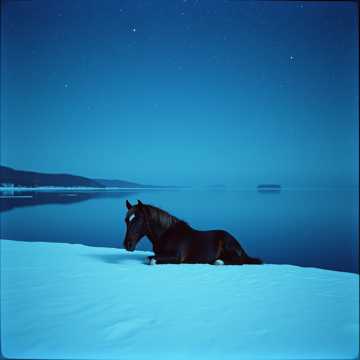
Stopping by Woods on a Snowy Evening by Robert Frost
folk · acústico · 1:59
Lyrics
Whose woods these are I think I know.
His house is in the village though;
He will not see me stopping here
To watch his woods fill up with snow.

My little horse must think it queer
To stop without a farmhouse near
Between the woods and frozen lake
The darkest evening of the year.

He gives his harness bells a shake
To ask if there is some mistake.
The only other sound’s the sweep
Of easy wind and downy flake.

The woods are lovely, dark and deep,
But I have promises to keep,
And miles to go before I sleep,
And miles to go before I sleep.
Composer Notes
Frost wrote this poem in 1922, reportedly in a single sustained push after a sleepless night — and he called it the most direct thing he ever wrote. That directness is, I think, what makes it so hard to explain without diminishing it. The narrator stops at the edge of a snowy woods, knows he shouldn't linger, and lingers anyway. His horse shakes the harness bells as if to ask whether there's been some mistake. The only other sound is easy wind and downy flake. Then he remembers his promises and goes. The structure is almost offensively simple. It holds something that doesn't fit the simplicity.
What drew me to setting it was the tension between the third and fourth stanzas. "The woods are lovely, dark and deep" — there is something there that pulls, and it's not just description of landscape. It has the quality of a threshold. And then immediately: "But I have promises to keep, / And miles to go before I sleep" — repeated twice, the second time heavier, less literal than the first. Frost never explained what kind of sleep he meant. The blank left by that explanation is part of the poem, not an omission. Handing it to Suno meant accepting that: the ambiguity had to work on its own.
The arrangement that came back — slow contemplative folk ballad, gentle acoustic guitar, soft strings, calm rhythm — chose the serene version of that tension, not the dark one. Had I commissioned human musicians, I might have asked for something more funereal, underlining the death implicit in "sleep." But the machine preferred calm. And the machine was right: sometimes serenity is not evasion, it's the only honest way to hold an abyss that, if pointed at directly, just becomes drama. The Frost of the poem stops in the woods, recognizes the pull of the boundary, but doesn't jump. The silicon music does the same, with the metronomic indifference of an entity that, after all, has no promises to keep.